Wednesday, April 29, 2009

National Safe Kids Week

National Safe Kids Week runs from April 26 to May 3, 2009. To kick off Safe Kids Week, Safe Kids and its founder Johnson & Johnson commissioned a safety study. (It’s the first time a scientific study has been released that links age-appropriate safety tips to children’s cognitive, behavioral and physical development.) Relevant study findings can be found below:


Did you know that infants…?

Have spines that are not fully developed, leaving them vulnerable to injury if they are not correctly positioned in a vehicle. They have a slower digestion rate and a lower tolerance for medication. Their skin is thinner and more sensitive, meaning it can burn more quickly than that of an adult. To keep your infant safer:

• Use a rear-facing, semi-reclined car seat until your baby is at least age 1 and 20 pounds. Use a rear-facing car seat longer if the seat has higher weight and height limits.
• Always follow directions and read labels when giving your baby medicine to avoid over-medicating.
• Do not hold an infant while cooking or carrying hot liquids and foods.

Did you know that children 1 to 4 years old…?

Have muscles and bones not yet fully developed. They are also still learning how to balance themselves and adjust their stance to avoid falls. They may wander off unsupervised to explore cupboards and drawers that may contain chemicals and poisons in them. To keep your 1-to 4-year old safer:

• Provide safe places to play. Only allow your child to play on playgrounds with 12 inches of safe surfaces such as shredded rubber, hardwood fiber/mulch or fine sand below the equipment to create a softer landing in case of a fall.
• Install stair gates so your curious child will not fall down stairs, and secure furniture to the wall to avoid it tipping over on them if they try to climb on it.
• Keep medicines and poisonous household items locked up and out of reach. Also, choose products with child-resistant packaging.

For information about Safe Kids Week events taking place around the country or for a copy of the Raising Safe Kids: One Stage at a Time report please visit www.usa.safekids.org.


Tuesday, April 28, 2009

Jennifer Lopez and the “Sounds of Pertussis”

Last Wednesday, I spoke with Jennifer Lopez and Alan R. Fleischman, M.D., medical director of the March of Dimes, about the “Sounds of Pertussis” national education campaign. They are the primary spokespeople for this joint initiative of the March of Dimes and sanofi pasteur. The goal is to raise awareness about the threat that pertussis (also known as whooping cough) can pose to infants. They recommend that all new parents should get an adult pertussis vaccine.

Photo courtesy of StartraksPhoto.com

Photo courtesy of StartraksPhoto.com

A few things that stood out to me on the call:
1. Jennifer Lopez practices what she preaches. I’m always curious as to why celebrities serve as spokespeople for various campaigns. Ms. Lopez mentioned that initially when she was a new mom (to her twins Max and Emme) she didn’t know about this. When she was approached about getting the message out, she thought, “Why wouldn’t I let people know that this exists and is easily prevented?” She and her sister wanted to do something with healthcare and education with a foundation that they’ve formed, so this fell right in line. (On a side note, both she and Marc – along with practically everyone else that they allowed their twins to be around in their early months – received the campaign’s recommended Tdap vaccination.)

2. Many of us have not received this information about the threat of pertussis from our doctors or our kids’ pediatricians because this is new information that is coming out. Since there has been a dramatic increase in cases of pertussis, bring up the topic and ask your doctor where to get the vaccine.

3. Since immunity wanes over time, all adolescents and adults (ages 11-64) should get the Tdap booster shot. It is especially important that those who will be around/caring for/in close contact with infants get a pertussis vaccine either before the pregnancy or immediately after the child is born.

To learn more about this “Sounds of Pertussis” campaign, please visit SoundsofPertussis.com. (Below is a short video about the campaign.)


Monday, April 27, 2009

Celebrate positive interactions with kids during Poetry Month

April is National Poetry Month. So, this is a great time to encourage your child to pick up a pencil and transport their thoughts onto paper. (Granted, most of our preschool aged children will need some help.) Teresa de Grosbois, children’s author and international speaker, shares some tips for parents trying to help their kids learn how to express themselves efficiently below:

teresadegrosbois3

1. When at a heightened emotional state, give children a pencil and paper and suggest they write down how they feel.

2. Have fun! Poetry is about emotion, and be sure to remind your children that expressing any and all emotion in poems is OK - whether it’s happiness, sadness or anger.

3. Clear your mind of thoughts, breathe deeply and see what comes out on paper. Stream of consciousness is a great style, and many times the first thoughts written down are already a form of poetry.

4. Be conscious of the rhyme or repeating rhythm in your poem.

5. When working on rhyming poems, sometimes a trick of the trade to use is working backwards. A lot of times the last line of a verse is the most powerful, so working backwards will prevent you from creating an
anti-climatic ending.

6. Look for opportunities to submit your child’s work for publication. Every parent knows to post their kids work on the fridge. Having it posted as an e-book or in print publication takes their self esteem through the stratosphere.

7. *Personal story: Teresa’s own daughter was encouraged to write this way, after sitting before her paper stumped and uninspired, and actually ended up writing a piece of work that became her first publishing.

Monday, April 20, 2009

MAKE ROOM FOR SAVINGS

Below are some money-saving tips from Laura Rowley a personal finance expert, Yahoo! Finance Columnist and mother of 3 kids.

LIVING ROOM: MAKE A LIVING FROM YOUR LIVING ROOM
Use your family room to unplug, literally. Vampire drain of electricity in “standby mode” –turned off but still plugged into the wall – drains our wallets $3 billion per year. Plug items into fuse-protected power strips that don’t suck energy from the wall when turned off.

Watch a little closer. Americans pay an average of $60 for cable, but only watch 15 channels, according to the Consumers Union. If you pay for premium cable, call your provider and put the service on “vacation mode.” You’ll still receive basic service but save temporarily on the extras – and get a good sense of whether you miss them. If you don’t, call the cancellation department and say you’re considering eliminating service altogether – this department has the best deals on hand to keep you as a customer.

HOME OFFICE: CREATE A HOME (OFFICE) TO CALL YOUR OWN
Rethink your ink. Equip yourself with items that stretch your dollars like Kodak’s All-in-One Inkjet printers, which can save you up to $110 a year on ink.

Channel your inner freegan. Sign up for free services like Skype that lets you make long distance calls online without spending a penny and faxzero.com, a service that allows you to fax for free by adding an ad coversheet to your faxes.

BATHROOM: DON’T FLUSH MONEY DOWN THE TOILET
Go with the low-flow. Water bills can be cut back 25 to 60 percent by replacing showerheads and faucets with low-flow aerating models for $10 to $20 each. Look for a model that’s 2.5 gallons per minute to save on average $200 per year.

A prescription to save. Only one-third of prescription drugs are mostly covered by insurance, according to a recent Consumer Reports survey. Prices can vary as much as $100 between designer and generic drugs so make sure you ask your physician for a generic equivalent, which can cost up to 40 percent less.

LAUNDRY ROOM: DON’T GET TAKEN TO THE CLEANERS ON YOUR DRY CLEANING
A dirty secret. Households spend an average of $1,500 a year on dry cleaning, and 65 percent of those clothes are washable, according to Proctor and Gamble research. Wool, cashmere, silk, rayon, polyester and spandex can all be laundered, saving America $750 a year.

(For more savings ideas and to calculate getting started, visit www.moneyandhappiness.com and www.printandprosper.com.)

Thursday, April 16, 2009

Healthy Teeth Tips from Dear Doctor

One of my favorite things about being a parenting writer is that I get to learn (and share!) about new developments that effect kids and their parents. Earlier this week I spoke with Dr. Mario Vilardi, president and publisher of Dear Doctor- Dentistry & Oral Health about the increase in dental erosion among young kids. He shared that over time, there has been a historical change in the way that kids are being fed, including what they drink. Now, more kids are drinking soft drinks, sports drinks and fruit juices. Since these liquids are more acid-based, they erode/cause the loss of tooth enamel over time. I took away some great tips to minimize/ prevent this loss of enamel thickness (some that go contrary to what we’ve been traditionally taught in regards to dental health) that I want to share with you.

Dr. Vilardi

Dr. Vilardi

1. Don’t rush to brush. Waiting for 30 to 60 minutes after sipping on a soda gives teeth time to re-harden after the acid softens surface enamel. Basically, the saliva neutralizes the effects of the acid/serves as a buffer/remineralizes the tooth surface. (This goes contrary to what I’ve always been taught - to brush immediately following meals.) Other options include eating a piece of cheese after drinking acidic drinks, because it also neutralizes the acidity of the drinks.

2. Grab a straw. If your child has a taste for juice that she just can’t shake, serve beverages with a straw. This reduces contact between these acidic beverages and teeth by allowing the acids to bypass most of the teeth.

3. Cash in on calcium. Calcium is added to many beverages to up their nutritional ante, and research has shown that the presence of calcium may reduce the erosive potential of soft drinks and that they remineralize the tooth surfaces better.

4. Explore natural alternatives. While your child is young and impressionable, take the opportunity to introduce them to beverages like milk and water. If this has proven unrealistic, limit the ingestion of acidic beverages to mealtimes because the rest of the food eaten at mealtime can neutralize the acids.

5. Only brush 2 times a day. Over-brushing can lead to other problems such as receding gums, the enamel being worn down, etc. Brushing twice a day with fluoride toothpaste should suffice.

6. Don’t eat right before bed. (No, this isn’t a diet tip.) It takes saliva about an hour to neutralize acids in your mouth, but saliva “shuts down” when you sleep. That’s why it’s best to finish your last meal/snack an hour or so before bed.

Overall, what I appreciated about Dr. Vilardi was that he was realistic. He wants parents to find balance, not to be excessive in regards to dental health. He stressed that preventive care is the best. Little things like avoiding simple sugars (sucrose/refined sugars/etc.) so that we don’t desensitize our kids’ taste buds are most helpful. (Sugar based products are a major problem because sugar converts to acid by the bacteria in our mouths – leading to tooth decay.) In any event, after the end of our talk, I was extremely grateful that there are dentists like Dr. Vilardi who focus on educating others to build good habits that lead not only to dental health, but also to overall health and well-being.

(To learn more about Dear Doctor, the nation’s leading consumer dentistry publication, please visit www.deardoctor.com.)

Monday, April 13, 2009

7 Spring Cleaning & Greening Tips From Julie Edelman

In keeping with our green theme of the month, I had a chance to speak with Julie Edelman as a preview to the Go Green Expo. Julie Edelman (aka “The Accidental Housewife”) is a best-selling author of “The Accidental Housewife: How to Overcome Housekeeping Hysteria One Task at a Time,” and the more recent follow-up, “The Ultimate Accidental Housewife: Your Guide to a CLEAN-ENOUGH House.” She will be speaking on the NATURAL PRODUCTS & A HEALTHY LIFESTYLE panel at the Expo on Sunday, April 19th at 11am.

edelman
You can also visit her website, The Accidental Housewife.

At the expo, Julie Edelman will be sharing some practical eco-friendly household tips. I asked her to share some green Spring Cleaning tips with Mom in the City readers. She encourages moms to focus on the simple “manicure-friendly” things to do to be a little greener.

1. Unplug cell phone chargers, blow dryers, curling irons, and other electronics that are not in use. This helps save phantom energy.

2. Switch from hot/warm water to cold when doing laundry. (Did you know that almost 90% of the energy used to wash clothes is used to heat the water?)

3. Don’t rush out to buy new compact fluorescent lamp (CFL) bulbs. Rather, wait for your current bulbs to blow. Then, switch them.

When it comes to Spring Cleaning, focus on high traffic/visibility rooms like the kitchen and bathroom

1. For general cleaning, use natural products (i.e. 1/3 cup of white vinegar combined with 2/3 cup of water in a spray bottle) as a cleaning spray.

2. To clean drains, pour ½ cup of baking soda down the drains and ½ cup of white vinegar until if foams. Boil a kettle of water and pour it down the drain in order to release the sediment.

3. Use reusable microfiber cloths to clean. You can use water to clean the windows with them. They also come with handles so that you can clean ceiling fans and higher windows. As an alternative, you can use a 1/3 cup white vinegar and 2/3 cup water mixture to clean the windows.

4. Use newspaper because it absorbs moisture and odor. You can dry windows with them and put them in the bottom of garbage pails. (You can also stuff your kids’ wet shoes with them.)

Overall, Julie stressed that kids learn by example. I agree. That’s why in every area (including going green) it’s important to strike a balance and not be extreme. Rather than stressing out about making every area of our live green at once, it’s better to focus on easy ways to blend green living into our day to day lives. (On a side note, if you’re in the NYC area, adults can get a weekend pass to the Go Green Expo for Saturday & Sunday, April 18 & 19 for $10. Children under the age of 12 are free.)

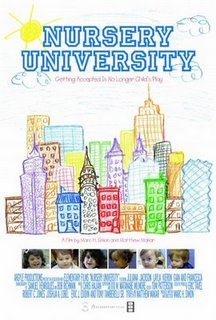
Nursery University

Recently, Mom in the City reviewer Jennifer Lehner attended a private screening of the upcoming movie Nursery University, a film which exposes the comedic aspects of the cut-throat world of pre-school admissions.

nurseryuniersity

Jennifer’s thoughts…

Gone are the days when preschool meant plunking down $35.00 for annual tuition and dropping your kid off in the church basement at the top of your street with a bunch of other four year olds. Applying to preschool for one’s toddler in 21st century Manhattan, as “Nursery University,” the new documentary film by Marc H. Simon and Matthew Maker makes clear, is a veritable blood sport.

“Nursery University”, in a refreshingly balanced and non-sensationalistic way, chronicles the preschool rite of passage for five diverse families during the 2006 admissions year, interspersing footage of their journey through the process with interviews with those on the other side—preschool admissions consultants and preschool directors.

If you’ve already had the pleasure of chaperoning your child through the preschool admissions process in New York City or if you are a New Yorker with a child who is nearing preschool eligibility age, you should go see this movie. It will be interesting to see if the film, though, has already passed its sell-by date and now just seems a quaint relic of what over-privileged New Yorkers did during the not-so-long-ago go-go years of the early 21st century.

The movie starts Friday, April 24th in NYC at Phoenix Adlabs ImaginAsian Theatre, 239 E. 59th Street (between 2nd and 3rd Avenues).

THE END